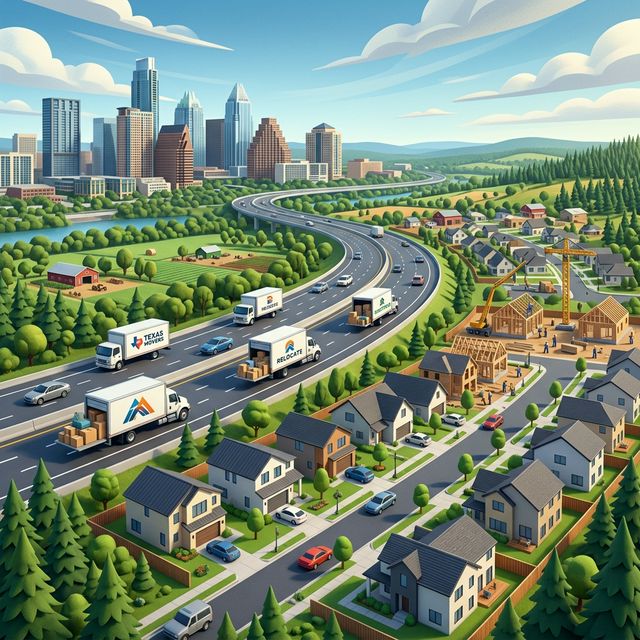
Drive east on Highway 71 from Austin and you will pass through a landscape that is changing faster than most longtime residents can keep up with. What used to be ranch land, hayfields, and old-growth pines is now subdivisions, concrete pads, and construction cranes. Bastrop County’s population has surged from 74,381 in 2010 to an estimated 122,531 in 2026 — a 64.7% increase in just sixteen years.
That is not abstract. That is 48,000 new neighbors. New cars on your roads. New kids in your schools. New voters in your elections.
And the single largest source of those new residents is Travis County — Austin.
Where They Are Coming From
Census Population Estimates Program data and IRS county-to-county migration files paint a clear picture of who is moving to Bastrop County and where they are coming from.
Roughly 3,100 net domestic migrants arrive in Bastrop County each year, plus an additional 242 international arrivals. Here is the breakdown:
-
Travis County (Austin): 38%. This is the dominant driver — more than a third of all new Bastrop County residents come from Austin. They are priced out of the Austin market, looking for acreage, or commuting via the Highway 71/290 corridor. They bring Austin incomes and, in many cases, Austin politics.
-
Other Texas counties: 27%. Williamson, Hays, and Caldwell counties contribute the next wave. This is the broader Austin metro spillover effect — people who may have already moved once from Austin to Round Rock or San Marcos and are now moving again as those areas also become expensive.
-
Other U.S. states: 22%. California, Washington, and New York lead the list. These are often tech workers relocating to the Austin area (or directly to Bastrop County for Tesla, SpaceX, or remote work) who bypass Austin entirely and buy in Bastrop from the start.
-
Natural increase: 9%. Bastrop County recorded 442 net births over deaths in the 2023-2024 period. This is modest compared to in-migration but still contributes to the growth trajectory.
-
International: 4%. Approximately 242 net international arrivals per year, a small but growing share.
The Tesla and Tech Effect
You cannot talk about Bastrop County growth without talking about Tesla. The Gigafactory in southeastern Travis County, just minutes from the Bastrop County line, employs more than 20,000 workers. Many of those workers live in Bastrop County because the housing is more affordable and the lots are larger.
SpaceX’s Starbase operations and The Boring Company’s headquarters (which is actually in Bastrop County) add another 3,500 or more jobs in the immediate area. These are high-income engineering and manufacturing positions. The workers who fill them tend to be younger, college-educated, and accustomed to urban amenities.
Beyond the marquee employers, an estimated 15,000 or more Austin metro commuters now live in Bastrop County. They work in Austin — or work remotely for Austin-based companies — but their mailing address, their property taxes, and their voter registration are in Bastrop County.
This creates a county that is economically tethered to Austin while politically and culturally distinct from it. Or at least, it has been distinct. Whether it stays that way depends on what happens next.
The Profile of the Typical Newcomer
Census and economic data allow us to sketch a composite profile of the typical new Bastrop County resident:
- Occupation: Tech, engineering, or remote knowledge worker
- Previous residence: Austin (Travis County) or California via Austin
- Reason for moving: Affordability and acreage — Austin income, rural cost of living
- Education: Bachelor’s degree or higher (the county’s college attainment rate of 25.5% is rising as newcomers arrive)
- Household income: Median of $82,730, above the Texas average and climbing
- Age: The county’s median age has dropped from 38.4 to 37.5 years in five years — the newcomers are younger than the existing population
- Political lean: Center to center-left on social issues; tax-sensitive on economic issues
That last point deserves emphasis. These are not people who moved to Bastrop County to change it politically. Most of them moved for the same reasons anyone does: more house for the money, more space for their kids, a shorter commute than they expected. But they bring their voting habits with them, and those habits were formed in Travis County, where Democrats win 70% or more of the vote.
What the Numbers Say About Political Impact
Bastrop County remains solidly Republican. Donald Trump carried the county 58.6% to 40.1% in 2024. County Judge Gregory Klaus won the GOP primary with 63.8% in March 2026. State Representative Stan Gerdes won his 2024 general election with 69.5%.
But the trend lines tell a more nuanced story.
In the March 2026 primary, Democrats accounted for 44.5% of competitive primary voters in House District 17 — in a county Trump won by nearly 19 points just sixteen months earlier. That gap between presidential performance and primary engagement suggests a Democratic base that is growing and becoming more organized.
The voter rolls have swelled from 45,137 registered voters in 2016 to 62,294 in March 2026 — a 38% increase. Those 17,000 new registered voters did not all come from the same political tradition. And in a primary where only 30% of registered voters showed up, the composition of who actually votes matters enormously.
What Growth Means for Your Daily Life
The political implications get the headlines, but growth affects Bastrop County in ways that are far more immediate and personal.
Roads and traffic. Highway 71 and SH 130 carry the bulk of commuter traffic between Bastrop and Austin. Both corridors are under increasing strain. The Texas Department of Transportation has multiple projects planned or underway, but infrastructure spending consistently lags behind population growth. If you drive 71 during rush hour, you already know this.
Schools. Bastrop ISD and the other school districts in the county are absorbing hundreds of new students each year. New school construction, staffing, and bond debt are all rising. School bonds are repaid through property taxes, which means growth drives both demand for new schools and higher tax bills to pay for them.
Water. Bastrop County sits over the Carrizo-Wilcox Aquifer, and water availability is one of the most consequential long-term constraints on growth. The Lost Pines Groundwater Conservation District manages local groundwater resources, but the tension between residential development and sustainable water supply is real and growing.
Property taxes. As covered in our property tax guide, Bastrop County’s effective tax rate runs 1.4% to 1.5% — well above the state average. Growth drives appraisals higher, which drives tax bills higher, even when rates hold steady. For longtime residents on fixed incomes, this can be devastating.
Character of the community. This is harder to quantify but impossible to ignore. Bastrop County has a distinct identity rooted in ranching, timber, small-town values, and generational families. The influx of urban transplants brings different expectations about government services, land use, school curriculum, and community standards. Managing that cultural transition — without losing what makes Bastrop County worth living in — is the defining challenge of the next decade.
What Conservatives Should Be Doing About It
Growth is not going to stop. The economic forces driving people from Austin to Bastrop County are structural: housing costs, remote work, Tesla, and the broader decentralization of the Austin metro. Bastrop County will likely cross 140,000 residents by 2030 and could approach 160,000 by 2035.
The question for conservatives is not how to stop growth. It is how to engage the people who are arriving.
1. Engage new residents early. Most newcomers are not politically locked in. They moved for practical reasons, not ideological ones. The first organization that reaches them — with a welcome, with information about local issues, with an invitation to participate — has an outsized chance of shaping their political engagement. That organization should be us.
2. Lead on the issues newcomers care about. Property taxes, school quality, road infrastructure, and water. These are not partisan issues in the abstract, but they become partisan when one side shows up with solutions and the other side is absent. Conservatives have a natural advantage on fiscal discipline and responsible growth — but only if we articulate it clearly and consistently.
3. Show up in every election. The March 2026 primary had 29.9% turnout. The May uniform election will likely have even less. School board races, city council seats, and bond elections are decided by tiny margins. Every conservative who votes in these low-turnout races carries ten times the influence of a presidential-year voter.
4. Build relationships, not walls. Many of the people moving to Bastrop County are tax-sensitive, family-oriented, and skeptical of government overreach. They are persuadable — but not if the first thing they encounter is hostility toward newcomers. The conservative case for Bastrop County is compelling: low regulation, strong community, excellent quality of life, and fiscal responsibility. Make that case to every new neighbor you meet.
5. Run for office. The most direct way to shape the future of Bastrop County is to serve. School boards, city councils, water districts, the commissioners court — these positions determine the policies that affect your daily life far more than anything happening in Washington. If you are a conservative who cares about this county, consider putting your name on a ballot.
The Bottom Line
Bastrop County is not the same place it was in 2010, and it will not be the same place in 2030. The growth is real, it is accelerating, and it is overwhelmingly driven by Austin overflow. The people arriving bring economic energy, higher incomes, and demand for services. They also bring political habits formed in one of the most liberal cities in Texas.
The conservative majority in Bastrop County is not guaranteed. It was built by generations of residents who showed up, participated, and led. Keeping it requires the same commitment — plus the willingness to welcome, engage, and persuade the 48,000 new neighbors who have arrived in the last decade and a half.
The future of Bastrop County will be decided by whoever shows up. Make sure it is you.
Demographic and migration data sourced from Census Bureau Population Estimates Program, IRS Statistics of Income county-to-county migration files, Texas Workforce Commission, and the RedStateTexas.com/BastropCounty intelligence dashboard. Population projections are estimates based on current trends.
Bastrop County Conservatives is a community organization dedicated to promoting conservative values and civic engagement in Bastrop County, Texas. Visit BastropCC.com to get involved.