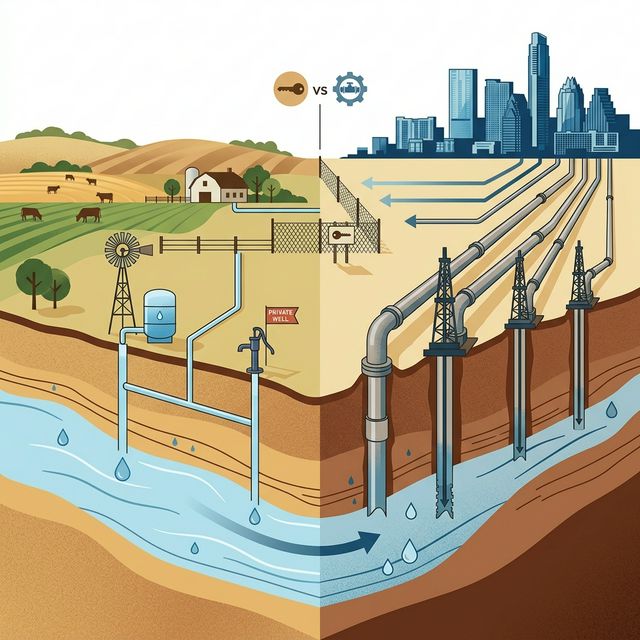
In 2025, the City of Austin tried to turn Bastrop County’s underground water supply into its personal storage tank. The plan was called Aquifer Storage and Recovery (ASR), and if it had gone through, it would have injected billions of gallons of treated Austin drinking water into the Carrizo-Wilcox Aquifer — the same aquifer that thousands of Bastrop County families depend on for their private wells.
The community said no. Loudly. Unanimously. And in November 2025, Austin Water withdrew the project entirely.
Here is the full story of what happened, why it mattered, and why the fight is not entirely over.
What Austin Was Proposing
Austin Water’s long-term water supply plan, called Water Forward, identified Aquifer Storage and Recovery as a critical strategy for meeting the capital city’s water needs through 2080. The concept is straightforward in theory: during wet years when Austin has surplus treated water, inject it underground into a suitable aquifer for storage. During drought years, pump it back out and use it.
The problem was where Austin chose to do it.
Austin Water selected the Carrizo-Wilcox Aquifer in Bastrop County as the target formation. The project, estimated at $1.5 billion, planned to store an initial volume of approximately 60,000 acre-feet of treated water, with potential expansion to 300,000 acre-feet by 2080.
A three-year field study was proposed as the first phase, designed to assess water quality interactions, monitor the behavior of injected water as it mixed with native groundwater, and evaluate potential impacts on neighboring private wells.
Why Bastrop County Opposed It
The opposition was immediate, bipartisan, and overwhelming. Residents, county officials, city councils, and groundwater conservation districts all raised alarms. The concerns fell into several categories:
1. Well Contamination and Depletion
Thousands of Bastrop County residents rely on private wells drawing from the Carrizo-Wilcox Aquifer. The fear was straightforward: injecting large volumes of treated municipal water into the aquifer could alter pressure dynamics, push contaminants into well zones, or deplete water availability for existing users.
Austin Water’s assurances that injected water would be “treated drinking water” did not satisfy critics, who pointed out that the chemistry of treated surface water differs significantly from native groundwater. Mixing the two creates unpredictable interactions, including the potential mobilization of naturally occurring arsenic and other heavy metals.
2. PFAS — “Forever Chemicals”
One of the most explosive concerns was PFAS — per- and polyfluoroalkyl substances, commonly known as “forever chemicals.” These synthetic compounds are nearly indestructible in the environment and have been linked to cancer, thyroid disease, liver damage, and immune system disruption.
While Austin Water released EPA-mandated monitoring results in late 2024 and early 2025 showing that its treated drinking water had “little to no detectable traces of PFAS” below upcoming regulatory limits, critics were not reassured. PFAS are measured in parts per trillion. Detection limits and regulatory thresholds are still evolving. And once PFAS are injected into an aquifer, they cannot be retrieved.
The argument was simple: even if Austin’s water meets current PFAS standards today, injecting it into Bastrop County’s aquifer creates a permanent, irreversible risk. If future testing reveals contamination, or if standards tighten (as they are expected to), the damage would already be done — and it would be Bastrop County’s problem, not Austin’s.
3. Property Rights
For many Bastrop County residents, the ASR project represented a fundamental property rights issue. Texas groundwater law gives landowners the right to the water beneath their property. Austin’s plan to use Bastrop County’s aquifer as a storage reservoir — without the consent of the people who depend on it — struck many as an overreach by a large city at the expense of a smaller, rural community.
The Bastrop City Council formally rejected a collaboration agreement with Austin Water, passing a resolution that highlighted the “potential for significant harm to groundwater resources and private property rights.”
4. Lack of Local Benefit
Austin’s ASR project was designed to serve Austin. The water stored in Bastrop County’s aquifer was Austin’s water, to be pumped back to Austin during drought. Bastrop County assumed all the risk — contamination, well interference, environmental damage — for zero direct benefit. There was no plan to share the stored water with Bastrop County residents, no revenue-sharing proposal, and no meaningful compensation for the risk.
The Legislative Fight
Bastrop County’s opposition extended to the state capitol. During the 2025 legislative session, House Bill 1523 was introduced to provide additional protections for the Carrizo-Wilcox Aquifer and address local concerns about the ASR project. The bill aimed to ensure that communities where ASR projects are proposed have a meaningful voice in the approval process.
The bill did not pass. In June 2025, the project advanced after the Bastrop-backed legislation failed in the legislature, prompting a wave of frustration among residents who felt the state had failed to protect their interests.
But the political pressure continued. Bastrop County officials, groundwater conservation district leaders, and community organizers maintained a sustained campaign of opposition through public hearings, media coverage, and direct engagement with Austin Water leadership.
Austin Backs Down
In November 2025, Austin Water announced that it was withdrawing its plans to pursue the ASR project in Bastrop County. The utility cited “a lack of collaboration” in the county as the reason for the decision.
That framing was, to put it mildly, disputed by Bastrop County residents. The “lack of collaboration” was, in fact, a united community telling a much larger city that it could not use their aquifer as a storage facility without consent, without adequate safeguards, and without sharing any of the benefits.
Austin Water subsequently announced plans to begin field testing for an ASR project in the Trinity Aquifer in Eastern Travis County, with testing scheduled to start in 2027. The Carrizo-Wilcox project in Bastrop County was shelved.
Why This Still Matters
The immediate threat has passed. Austin is not currently pursuing aquifer storage in Bastrop County. But several factors make this an issue worth watching:
Austin’s water needs are not going away. The capital city is projected to grow to 1.5 million people by 2040. The Water Forward plan assumes 300,000 acre-feet of ASR storage by 2080. If the Trinity Aquifer site in Travis County proves inadequate, Austin may look east again.
The legislative protections are still weak. HB 1523 failed. There is currently no state law that gives communities like Bastrop County a clear veto over ASR projects proposed within their jurisdictions. A future legislature could approve a framework that makes it easier for large cities to use rural aquifers for storage, with or without local consent.
The aquifer is a shared resource. The Carrizo-Wilcox Aquifer spans multiple counties across Central and South Texas. Bastrop County is not the only community that depends on it. Any large-scale alteration of the aquifer’s hydrology — whether from ASR injection, industrial pumping, or agricultural drawdown — affects everyone downstream.
The precedent matters. Bastrop County’s successful opposition to the ASR project demonstrated that a smaller community can push back against a much larger city’s infrastructure plans. But it required sustained organizing, political engagement, and a willingness to fight at both the local and state levels. That kind of effort cannot be taken for granted.
What Conservatives Should Take From This
The Austin Water ASR fight is a textbook example of the issues that define conservative governance at the local level: property rights, limited government, local control, and environmental stewardship.
Bastrop County did not oppose the project because it was anti-growth or anti-Austin. It opposed the project because it represented a large government entity imposing risk on a smaller community without consent, without adequate safeguards, and without accountability.
That is the kind of issue that should mobilize every conservative in the county. And to the credit of Bastrop County’s elected officials, residents, and community organizations, it did.
The lesson: when your community is organized, informed, and willing to show up, you can win — even against a city with ten times your population and a hundred times your budget.
Key Takeaways
- Austin Water proposed a $1.5 billion Aquifer Storage and Recovery project to inject treated drinking water into the Carrizo-Wilcox Aquifer in Bastrop County
- Local opposition was universal — residents, city councils, county officials, and groundwater districts all opposed it
- Key concerns included private well contamination, PFAS “forever chemicals,” property rights violations, and zero local benefit
- Legislative efforts (HB 1523) to protect the aquifer failed in the 2025 session, but political pressure continued
- Austin Water withdrew the project in November 2025, citing “lack of collaboration”
- The underlying dynamics have not changed — Austin still needs water, and the Carrizo-Wilcox Aquifer is still a target
Sources: Austin Water Forward Plan, Texas Education Agency Speakup Austin, Texas Scorecard, Bastrop City Council resolutions, Lost Pines Groundwater Conservation District, and community reporting. For more on Bastrop County issues, visit BastropCC.com.
Bastrop County Conservatives is a community organization dedicated to promoting conservative values and civic engagement in Bastrop County, Texas. Visit BastropCC.com to get involved.