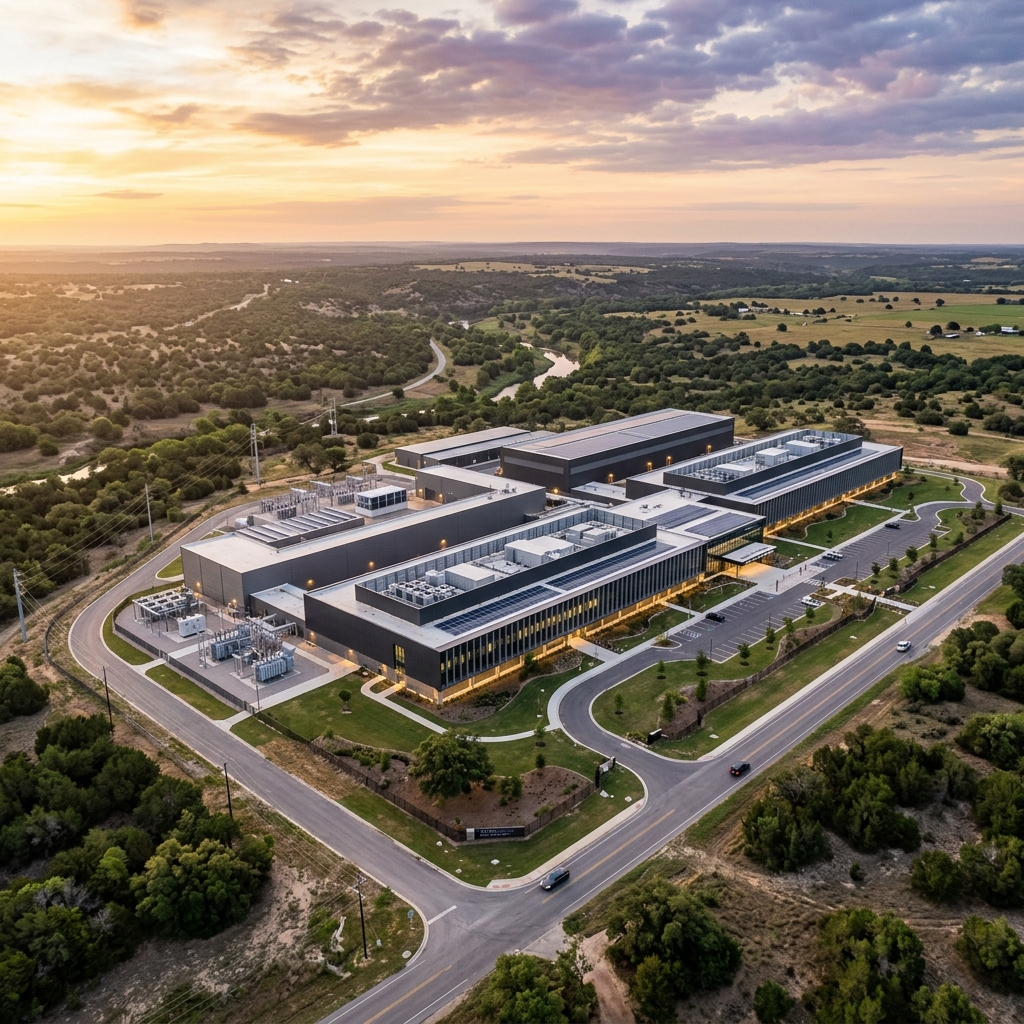
At the corner of FM 535 and Wolf Lane in Cedar Creek, something historic is taking shape. EdgeConneX, one of the largest data center developers in the world, is building AUS02, a $440 million, 578,000-square-foot facility set to come online in June 2026. And that is only the beginning.
AUS02 is the first of four buildings planned for a 140-acre campus, a full build-out that represents a potential $10 billion investment in Bastrop County. When complete, the campus will deliver 96 megawatts of capacity in its first phase alone, with an additional 48 MW and two more 96 MW buildings in future phases, powering the cloud services and artificial intelligence workloads that have become the backbone of the modern economy.
This is the kind of generational opportunity that most rural counties never get. It also comes with legitimate tradeoffs that deserve honest examination. Before the noise of social media takes over the conversation, Bastrop County residents deserve the full picture, the good, the bad, and the gray areas in between.
The Case for the Data Center: Why Proponents Say This Matters
Economic developers have a term for what happens when a billion-dollar commercial project lands in a rural county. They call it the Net Community Benefit, comparing what a project pays into the tax base against what it costs the county in new services.
Compare the math on two different growth paths:
A 1,000-home subdivision at roughly $300 million in combined property value adds an estimated 1,500 new students to the Bastrop or Smithville ISDs, sharply increases daily traffic, puts new strain on emergency services, and pressures the county’s water infrastructure.
A $10 billion data center campus, by contrast, adds zero new students, generates minimal daily vehicle traffic, operates its own on-site security and fire suppression systems, and typically funds its own utility upgrades.
On paper, a data center campus is one of the most tax-efficient commercial assets any county can host. It generates property tax revenue while requiring almost none of the public services that residential growth demands.
That surplus flows in three directions, all of which benefit local families.
1. Revenue for Schools Without New Students
Rural independent school districts in Texas have historically operated on tight budgets. A hyperscale data center campus injects millions of dollars into the local ISD through property taxes, and because no new students arrive with the facility, 100 percent of that revenue goes toward teacher pay, modernized classrooms, and better technology for the kids already here.
New revenue, no new cost pressure on the classroom. That is a genuine advantage.
2. Stronger Police, Fire, and EMS
Bastrop County’s population has been growing fast. Emergency services have been stretched to keep up. Voters recently approved Bastrop County Emergency Services District No. 3 (ESD #3), a new district-operated ambulance service funded by a property tax rate of $0.10 per $100 valuation. That new line item on your tax bill reflects the reality that growth, residential growth, in particular, puts direct pressure on emergency services budgets.
A large commercial taxpayer like EdgeConneX helps shoulder that burden. Revenue from commercial property taxes provides the liquidity counties need to fund fire engines, EMS stations, and sheriff’s deputies without pushing the entire bill onto homeowners.
3. Balancing the Tax Base
When a county’s budget runs short because of residential growth, the bill lands on individual property owners. A billion-dollar commercial asset on the tax rolls absorbs a significant share of the county’s total tax burden, which takes pressure off the homeowners who have lived here for decades.
Without major commercial taxpayers, the entire weight of county infrastructure falls on working families. That is the trajectory data center proponents argue we avoid when we welcome investment like this.
Now for the Hard Questions: What the Proponents Leave Out
A balanced picture requires looking at what data center advocates tend to gloss over. Here are the issues that Bastrop County residents are right to ask about.
The Tax Abatement Reality
This is the single most important detail that usually gets buried in the enthusiasm.
In December 2024, the Bastrop County Commissioners Court unanimously approved a 10-year property tax abatement for EdgeConneX. The terms: a 75 percent reduction on new county taxes assessed above the property’s 2024 base value, applied to each of the four planned buildings individually.
What does that mean in practice? For the first 10 years, Bastrop County will collect only 25 cents on every dollar of property tax that this campus would otherwise generate. On a $10 billion campus, the difference between the full tax revenue and the abated amount is enormous.
Proponents argue the abatement is necessary to win the project, that without it, EdgeConneX would build in another county or another state. That may be true. Texas is engaged in a fierce national competition for data center investment, and neighboring states offer aggressive incentives. But residents should understand what this means: the “billions in tax revenue” figure often cited in promotional materials is the unabated number. The actual revenue Bastrop County will collect during the first decade is a fraction of that.
After the 10-year abatement expires, the full property tax value kicks in. The long-term bet is that the campus will be worth hundreds of millions in annual tax revenue for decades to come. Whether you trust that bet depends on how you weigh a known sacrifice now against a projected benefit later.
Beyond the local abatement, data centers in Texas also qualify for state-level sales tax exemptions on electricity and equipment, an incentive that currently costs the state an estimated $1.6 billion per year in foregone revenue, a figure that has ballooned from roughly $30 million annually just a decade ago. The Texas Legislature is actively debating whether to reform or repeal these exemptions, with interim hearings scheduled for mid-2026. What happens in Austin could significantly change the economics for Bastrop County.
Permanent Jobs: Honest Numbers
The AUS02 construction phase is employing 400 to 600 skilled tradespeople daily, electricians, ironworkers, concrete crews, HVAC technicians. That is real, well-paid work happening in our county right now.
But once the facility is operational, EdgeConneX projects approximately 60 permanent positions with an estimated annual payroll of over $6 million. Those are quality jobs. They are also, candidly, not many jobs for a $440 million facility.
Proponents cite a 6x multiplier effect, that each direct data center job supports roughly six indirect and induced jobs across maintenance, catering, transportation, and professional services. That multiplier is real and documented in economic research. But it is important to distinguish between hundreds of construction jobs that end when building is complete and the smaller number of permanent positions that follow.
Sixty jobs is sixty jobs. It is not the employment engine that a manufacturing plant or regional hospital would provide. The economic case for the data center rests primarily on tax revenue, not job creation.
Water: The Concern That Was Right 10 Years Ago
Ten years ago, the concerns being expressed about data center water consumption were not just valid, they were prescient. Traditional data centers of the 2010s used evaporative cooling towers that consumed staggering amounts of freshwater. A single hyperscale facility could drink millions of gallons per day. In drought-prone Central Texas, that was a legitimate threat.
The industry has changed significantly since then.
EdgeConneX has publicly committed to achieving water neutrality by 2030. As of late 2025, the company reports that over 92 percent of its global portfolio uses dry cooling or no-water cooling systems. Their newer facilities, including the designs deployed for AI-ready campuses, use closed-loop chilled water plants combined with direct-to-chip liquid cooling, systems that recirculate coolant without consuming freshwater through evaporation.
How closed-loop cooling works: Unlike traditional evaporative towers that spray water into the air (losing it permanently), a closed-loop system circulates chilled water or liquid coolant through sealed pipes. The liquid absorbs heat from the servers, passes through a heat exchanger or dry cooler that releases the heat to the outdoor air, and then recirculates. No water is consumed in the process. It is the same basic principle as the radiator in your car, the coolant loops continuously without being “used up.”
For any residual water used in occupancy, landscaping, or maintenance, EdgeConneX invests in water replenishment projects to offset consumption, partnering with environmental organizations to restore local watersheds.
Total freshwater consumption by all U.S. data centers combined was less than 0.5 percent of America’s total freshwater use in 2023. For context, American cities lose an estimated 3 trillion gallons annually through leaking municipal pipes alone, roughly 15 times more water than every data center in the country consumes combined.
The bottom line on water: The fears are understandable. They were grounded in real technology that existed a decade ago. The industry has largely moved past that technology. Whether EdgeConneX deploys its stated closed-loop and dry-cooling systems at the Cedar Creek campus specifically is something Bastrop County leaders should confirm in writing as a condition of the project proceeding.
Energy: Both an Asset and a Concern
Modern hyperscale data centers are massive electricity consumers. The Cedar Creek campus is designed for 96 MW in its first phase alone, enough to power roughly 70,000 average Texas homes. At full build-out across four buildings, total demand could reach approximately 336 MW.
EdgeConneX has been moving aggressively toward behind-the-meter power generation, building dedicated power plants co-located with their data centers. In New Albany, Ohio, the company has secured regulatory approval for natural gas-fired power plants with on-site battery energy storage systems (BESS). This approach bypasses grid interconnection delays and reduces load on the local utility.
The upside: If EdgeConneX generates its own power at Cedar Creek, the campus would draw little to no electricity from the local grid. Even better, on-site battery storage systems can export surplus power to the grid during peak demand events, the kind of brutal Texas summer heat waves that stress ERCOT. In that scenario, the data center campus actually becomes a grid stabilizer, not a burden.
The concern: Not every EdgeConneX facility uses behind-the-meter generation. Some campuses still rely on the local utility grid entirely. If the Cedar Creek campus draws 96 to 336 MW from the ERCOT grid without self-generation, that is a meaningful load increase in a region where transmission infrastructure was not designed for hyperscale industrial demand. Whether the facility’s power approach includes on-site generation, grid draw, or a hybrid should be a matter of public record.
Additionally, if on-site power generation relies primarily on natural gas turbines, the campus will produce local emissions, something that pure grid-draw facilities do not. The environmental trade-off between grid independence and on-site combustion is real and worth tracking.
Noise and Quality of Life
This is the concern that rarely appears in economic development presentations but shows up immediately in communities where data centers are built. Residents near hyperscale facilities in other Texas communities have reported persistent low-frequency hum from HVAC systems, high-velocity cooling fans, and backup generators that operate around the clock.
In rural communities where ambient noise is typically very low, the kind of quiet that drew families to places like Cedar Creek in the first place, industrial noise can significantly affect quality of life, sleep, and property enjoyment, especially for adjacent landowners.
Whether EdgeConneX has committed to specific noise mitigation measures, sound walls, setback distances, maximum decibel levels at the property line, is another question Bastrop County residents should be asking.
Who Is Opposing Data Centers — and Why?
Understanding the full picture means understanding the opposition. While data centers bring significant economic benefits and technological advancement, they are not without critics. According to research compiled by TomorrowBeginsHere.com, opposition to data center development generally falls into four categories.
1. Local Environmental Groups & Activists
Certain local environmental organizations frequently oppose data center projects. Their primary concerns revolve around resource consumption, specifically water usage for cooling systems and electricity demands. While modern data centers increasingly rely on closed-loop systems that reuse water and renewable energy sources, historical perceptions of high consumption continue to drive opposition from these groups.
2. “NIMBY” (Not In My Backyard) Residents
It is natural for residents living immediately adjacent to proposed development sites to express concerns about how construction and operations might affect their daily lives. Key issues typically raised include construction noise, increased traffic during the building phase, and questions about the visual footprint of the facilities compared to the existing rural landscape.
3. Misinformation Campaigns
The complex nature of cloud computing infrastructure often makes it a target for misinformation. Some organized opposition stems from groups that circulate out-of-context data, conflating standard data centers with highly polarizing topics like cryptocurrency mining, or presenting outdated statistics regarding power and water efficiency from decade-old facilities.
4. Competing Developers
Occasionally, opposition is quietly funded or supported by competing land developers or interests who wish to utilize large tracts of land for alternative commercial or residential purposes, viewing data centers as competition for prime real estate and resources.
Opposition Transparency — Direct Campaign Links
We encourage residents to review opposition materials directly so they can form their own informed opinions:
- MediaJustice: “The People Say No: Resisting Data Centers in the South” (September 2025)
- Southwest Workers Union: “Data Center Rebellion Convening 2026” (March 2026)
- Clayton Tucker for TX Ag Commissioner: “Stop AI Centers”
- NAACP: “Stop Dirty Data Centers” Campaign Page
- Data Center Watch Report: $64B Blocked/Delayed Projects
- MacArthur Foundation: Grant Record for MediaJustice
- Climate Justice Alliance: Funders & Donors Page
- CodePink: “The Dark Side of the Data Center Boom”
Additional News & Reports:
- Texas Tribune: “Texans are demanding their local governments push pause on data centers” (February 2026)
- Reporting Texas: “Texans Demand Special Legislative Session for Data Center Debate” (February 2026)
- Taylor Press: “In Taylor, critics rally against data centers” (March 2026)
- NAACP: “2026 Recommendations for Protecting Frontline Communities” (January 2026)
- Data Center Watch: Full database of 142 activist groups across 24 states
The existence of organized opposition does not mean the opposition is wrong, and the existence of economic benefits does not mean the project should proceed without scrutiny. Bastrop County residents deserve to hear every side and evaluate every claim on its merits. For a deeper dive into myth versus reality, visit TomorrowBeginsHere.com/myth-vs-reality.
A Piece of a Bigger Picture
The EdgeConneX investment does not exist in isolation. Bastrop County has quietly become one of the most important technology corridors in the state, home to Tesla’s manufacturing and headquarters, xAI, Starlink, The Boring Company, and Neuralink. A $43 million grant is also extending gigabit fiber across the county, delivering fast broadband to every resident.
This is a virtuous cycle. Serious capital attracts more serious capital. Bastrop County is positioning itself to capture a generation of growth while preserving the historic character and natural beauty that make this such a special place to live.
But virtuous cycles only remain virtuous if the community insists on transparency, accountability, and fair terms. Growth without guardrails is just sprawl with a better press release.
The Bottom Line for Bastrop County
AUS02 is more than a building. It is a bet, one that could pay off enormously for Bastrop County, or one that could deliver less than promised if the details are not nailed down.
Here is what is genuinely positive:
- A potential $10 billion in long-term property value on the tax rolls
- Revenue for schools without adding a single new student
- Hundreds of construction jobs now, and approximately 60 permanent positions
- Modern closed-loop cooling technology that represents a real advance over the water-hungry facilities of a decade ago
- Potential grid stabilization from on-site power generation and battery storage
- Positioning Bastrop County in the national technology economy alongside Tesla, xAI, and Starlink
Here is what residents should watch carefully:
- The 10-year, 75% property tax abatement means the county collects a fraction of the full tax value during the project’s first decade
- Sixty permanent jobs is a modest number for a $440 million investment
- Whether EdgeConneX will actually deploy closed-loop cooling and behind-the-meter power generation at Cedar Creek specifically, not just at other campuses
- Noise impact on adjacent rural properties
- The ongoing state-level debate over data center tax exemptions could change the fiscal picture
- Whether Bastrop County negotiated clawback provisions if EdgeConneX fails to deliver on investment or job commitments
The math can work. But the math only works if the terms are right and if our county leaders are holding developers to enforceable commitments, not press-release promises.
Want the full picture? For deeper research on data center water use, grid impact, economic modeling, and the Bastrop County story specifically, visit TomorrowBeginsHere.com, an independent educational resource focused on the facts.
Get involved. If you want Bastrop County to stay on this growth trajectory while protecting what makes our community special, stay informed, show up to county meetings, and demand specifics. That is how rural communities win, not by saying no to everything, and not by saying yes to anything, but by saying yes to the right deal on the right terms.