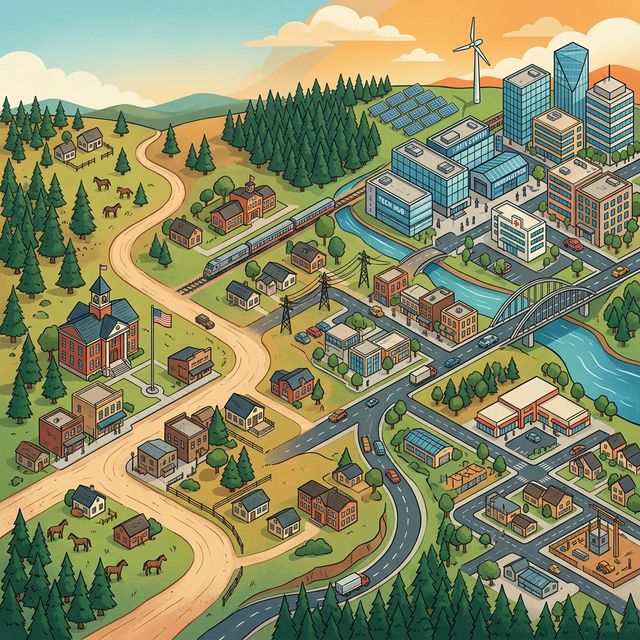
In 2010, the U.S. Census counted 74,381 people living in Bastrop County. Today, the estimated population is roughly 122,500. That is a 64% increase in just 15 years, a pace of growth that has transformed every corner of the county, from the downtown square in Bastrop to the rural roads outside Elgin, Cedar Creek, and Smithville.
But this growth did not happen all at once, and it did not happen by accident. It came in waves, driven by Austin’s expansion, major economic investments, natural disasters, and the decisions of tens of thousands of families looking for a different kind of life east of the capital.
Here is the story of how Bastrop County went from a quiet rural community to one of the fastest-growing counties in Texas.
Before the Boom: A County With Deep Roots
Bastrop County’s history stretches back to the 1820s, when Stephen F. Austin’s colonists settled along the Colorado River. Named for the Baron de Bastrop, a friend of Austin, the county was formally established by the Republic of Texas in 1837. For more than a century, the local economy ran on cotton, cattle, and timber, with the Lost Pines forest giving the region its distinct character among the rolling prairies of Central Texas.
The county’s population peaked around 26,800 in 1900, then entered a long decline as young people left for cities and the agricultural economy contracted. By 1960, the population had fallen to just 16,925. Camp Swift, a massive World War II Army training base that briefly swelled the area’s population during the 1940s, wound down after the war and took jobs with it.
Growth resumed slowly through the 1970s and 1980s as Austin began creeping eastward. By 1980, the population had recovered to 24,726. By 1990, it reached 38,263. The 2000 Census recorded 57,733 residents, marking the first time in a century the county had more than doubled in a single generation.
But the real acceleration was still ahead.
2010: The Starting Line
Population: 74,381
The 2010 Census established the baseline that makes today’s growth numbers so striking. Bastrop County was still largely rural, with wide stretches of ranchland, a handful of small towns, and a modest commercial footprint along Highway 71. The Hyatt Regency Lost Pines Resort, which opened in 2006, was one of the first signs that the area was attracting investment beyond agriculture and small business.
The county’s voter rolls held about 45,000 registered voters. The median household income was below the state average. Housing was affordable, land was cheap, and the pace of life was slow. Austin, just 30 miles northwest, was growing fast, but Bastrop County had not yet felt the full weight of that expansion.
That was about to change.
2011: Fire and Resilience
Population: ~76,000
On September 4, 2011, strong winds from the outflow of Tropical Storm Lee snapped trees onto power lines east of Bastrop, igniting what would become the most destructive wildfire in Texas history. The Bastrop County Complex Fire burned for 55 days, scorched more than 34,000 acres, destroyed 1,696 structures (including more than 1,600 homes), and killed two people. Insured losses exceeded $325 million.
The fire consumed 96% of Bastrop State Park, devastating the Lost Pines ecosystem and the habitat of the endangered Houston toad. Communities like Circle D-KC Estates and Tahitian Village were devastated. Thousands of residents were evacuated, many for weeks.
The disaster could have broken the county. Instead, it revealed its character. Volunteers organized immediately. A Facebook page called “Bastrop Fire - Adopt a Family” launched within days. Musicians including Willie Nelson and the Dixie Chicks played a benefit concert that raised over $500,000. The Bastrop County Long Term Recovery Team formed within weeks and eventually rebuilt 133 homes.
The fire scarred the landscape, but it also forged a community identity that endures today. Ask anyone who lived through it, and they will tell you: Bastrop came back stronger.
2012-2015: Quiet Rebuilding
Population: ~76,000 to ~82,000
The years following the fire were a period of slow, steady recovery and early-stage growth. Rebuilding consumed much of the community’s energy and resources. Replanting of drought-hardy loblolly pines in the state park began in January 2013 and continued for years, with over two million seedlings planted.
Meanwhile, Austin’s tech boom was pushing housing prices higher, and the first wave of spillover migrants began arriving in Bastrop County. New subdivisions started breaking ground along the Highway 71 corridor. The county added about 1,500 residents per year during this period, modest by later standards but a meaningful uptick from the pre-fire pace.
By 2014, the county’s population reached approximately 78,000. The political landscape was shifting too. While Democrats had won local majorities as recently as the 1980s, Republican candidates were now competitive and increasingly dominant in county races, reflecting broader trends across rural and exurban Texas.
2016-2019: Austin Overflows East
Population: ~85,000 to ~95,000
This is when the growth curve steepened. Austin’s population had exploded past one million, and the surrounding counties, Williamson, Hays, and now Bastrop, were absorbing thousands of families priced out of Travis County. Bastrop County’s population grew by roughly 10,000 in four years.
New master-planned communities began taking shape. Retail followed the rooftops. Highway 71 transformed from a two-lane road through pine country into a commercial corridor with recognizable national chains. The Burleson Crossing shopping center expanded. New restaurants, medical offices, and service businesses opened at a pace Bastrop had never seen.
Voter registration climbed alongside population. By 2016, the county had about 45,000 registered voters. Turnout for the presidential election was 63%, and the county voted solidly Republican. The political character of the newcomers was mixed, but the conservative majority held firm.
Infrastructure began straining under the growth. Road congestion, water supply, school capacity, and emergency services all became topics of public debate. The Bastrop ISD bond program reflected the reality that the county’s schools needed to expand to keep up.
2020: Pandemic, Census, and a New Baseline
Population: 97,216 (Census)
The 2020 Census officially counted 97,216 residents in Bastrop County, a 31% increase over the 2010 count of 74,381. That made Bastrop County the 13th fastest-growing county in Texas over the decade.
But the count almost certainly understated the real number. The census was conducted during the COVID-19 pandemic, and estimates suggest the actual population was closer to 98,000 to 100,000 by mid-2020.
The pandemic itself accelerated growth. Remote work freed thousands of Austin-area professionals from the need to commute daily, making Bastrop County’s larger lots, lower prices, and rural feel suddenly more practical. Families who had been on the fence about moving 30 miles from the office found that the office was now their spare bedroom.
The 2020 presidential election saw the county’s voter rolls swell past 52,000, with 70.3% turnout, the highest of any cycle in the dashboard’s history. Trump carried the county comfortably, but the total vote count told the real story: 36,612 people voted, nearly 8,000 more than in 2016.
2021-2022: The Musk Factor
Population: ~100,000 to ~106,000
Two developments in 2021-2022 put Bastrop County on the national map in ways the community had never experienced.
First, Tesla’s Gigafactory opened in southeast Travis County in 2022, just a short drive from Bastrop County’s western border. While the factory itself sits outside the county, the economic ripple effects, housing demand from thousands of new Tesla employees, supply chain activity, and commercial development, spilled directly into Bastrop.
Second, Elon Musk’s other ventures began putting roots down inside Bastrop County itself. The Boring Company acquired over 250 acres along FM 1209. SpaceX filed plans for “Project Echo,” a 521,000-square-foot shell building on 170 acres acquired in the county. Construction on the SpaceX facility began in late 2022, with the building eventually becoming a Starlink manufacturing plant.
Population growth accelerated to roughly 3,000+ net domestic arrivals per year. The county crossed the 100,000 mark for the first time in its history, a milestone that would have been unimaginable a generation earlier.
2023: SpaceX Opens, Retail Follows
Population: ~108,000 to ~110,000
In September 2023, SpaceX opened its Starlink manufacturing facility at 858 FM 1209, a 500,000+ square foot plant focused on producing satellite hardware. In its first ten months of operation, the facility produced over one million Starlink antenna kits. SpaceX and The Boring Company together brought approximately 1,200 jobs to the area and injected over $48 million into the local economy through construction and operations.
Retail development surged to keep up with the residential growth. The Bastrop Economic Development Corporation reported a wave of new commercial activity: national chains, restaurants, medical offices, and service businesses all competing for space along the Highway 71 corridor and in new developments. The county’s total real estate market value was climbing rapidly, and the appraisal district’s workload expanded accordingly.
The Census Bureau’s American Community Survey estimated the county’s population had grown 13.9% between 2020 and 2023, with total population reaching approximately 102,370. Median household income had risen to $82,730. The median age was dropping, down to 37.5, reflecting the influx of younger families.
2024: Growth Becomes Undeniable
Population: ~114,931
By mid-2024, the Census Bureau’s Population Estimates Program placed the county at approximately 114,931 residents. The county was adding roughly 3,100 net domestic migrants per year, plus about 242 international arrivals, and had a natural increase of approximately 442 (births over deaths) annually.
The origin of these newcomers told the story. About 38% came from Travis County (Austin). Another 27% came from neighboring Texas counties, particularly Williamson, Hays, and Caldwell. Roughly 22% arrived from other states, with California, Washington, and New York leading the list. Only about 9% of growth came from natural increase, and 4% from international migration.
In November 2024, Donald Trump carried Bastrop County with 58.6% to Kamala Harris’s 40.1%. The county’s voter rolls had reached 61,423 registered voters, and 39,956 people cast ballots, the highest raw vote total in county history.
The county’s political character remained conservative, but the margins were being shaped by a rapidly changing electorate. Every cycle brought thousands of new registrations from newcomers whose political habits were still being formed.
2025: Billions in Development
Population: ~118,000 to ~120,000
The year 2025 marked the moment Bastrop County shifted from “quietly growing” to “major regional economic player.” Several landmark developments reached critical milestones:
SpaceX expansion: Governor Abbott announced a $17.3 million Texas Semiconductor Innovation Fund grant to SpaceX for a $280 million expansion of the Bastrop facility. The plan called for adding one million square feet over three years, creating over 400 jobs, and building the largest printed circuit board and panel-level packaging facility in North America.
Sendero groundbreaking: Pearl River Companies broke ground on the $300 million Sendero mixed-use development at Highway 71 and FM 969, with plans for 782 residential units, a hotel, 250,000+ square feet of retail and professional space, and a health and wellness campus.
LS Electric: The Korean manufacturer opened its first North American production facility in Bastrop, employing 50 workers with plans for $240 million in additional investment over five years.
Wyldwood Studios: Actor Zachary Levi announced a 75-acre film and entertainment development along the Colorado River.
$1.4 billion data center: Construction began on a massive data center in Cedar Creek, with the first of four buildings scheduled for completion in 2026.
Line204 Texas: A purpose-built, 546-acre studio lot began construction along the Colorado River.
Bastrop County also adopted a property tax rate increase from $0.40275 to $0.42870 per $100 of taxable value, with a total property tax revenue target of $44.5 million. The growth was generating revenue, but also generating costs: new schools, road improvements, water infrastructure, and expanded emergency services all competed for dollars.
2026: Where We Stand Now
Population: ~122,531 (estimated)
As of early 2026, Bastrop County’s estimated population stands at roughly 122,500. The county has grown 64% since 2010 and shows no signs of slowing down. Voter rolls have reached 62,294, up 38% since 2016.
The Bastrop ISD is building two new elementary schools to keep pace with enrollment growth. H-E-B is expanding its Bastrop location by 18,000 square feet with an in-store True Texas BBQ. A new Courtyard by Marriott, Sprouts grocery store, and dozens of restaurants are under construction or recently opened. The historic Old Iron Bridge is undergoing a $15 million restoration. Adelton, one of the county’s largest master-planned communities, is building out 1,200+ residential units.
The county that had 16,925 people in 1960 now has more than seven times that number. The county that rebuilt from a wildfire that destroyed 1,600 homes now has more construction cranes on the horizon than at any point in its history.
What the Timeline Tells Us
Bastrop County’s growth story is not a straight line. It is a series of inflection points: the slow recovery from agricultural decline, the Camp Swift boom and bust, the Austin spillover that began in the 1990s, the devastating 2011 fire that tested the community’s resolve, the pandemic-era remote work migration, and the Musk-era industrial transformation.
Each wave brought new residents, new economic activity, and new pressures. And each wave raised the same fundamental question: as the county changes, what stays the same?
For conservatives, the answer is civic engagement. The values that define Bastrop County, property rights, limited government, personal responsibility, strong families, faith-centered communities, did not survive by accident. They were maintained by people who showed up. At the ballot box, at commissioners court, at school board meetings, at candidate forums, and in everyday conversations with new neighbors.
The population has nearly doubled in 15 years. It will keep growing. The only question is who shapes what that growth looks like.
Population data sourced from the U.S. Census Bureau, Census Population Estimates Program, American Community Survey, Texas State Historical Association, and RedStateTexas.com/BastropCounty election intelligence dashboard. For the full interactive dashboard with voter data, migration patterns, and partisan analysis, visit RedStateTexas.com.
Bastrop County Conservatives is a community organization dedicated to promoting conservative values and civic engagement in Bastrop County, Texas. Visit BastropCC.com to get involved.