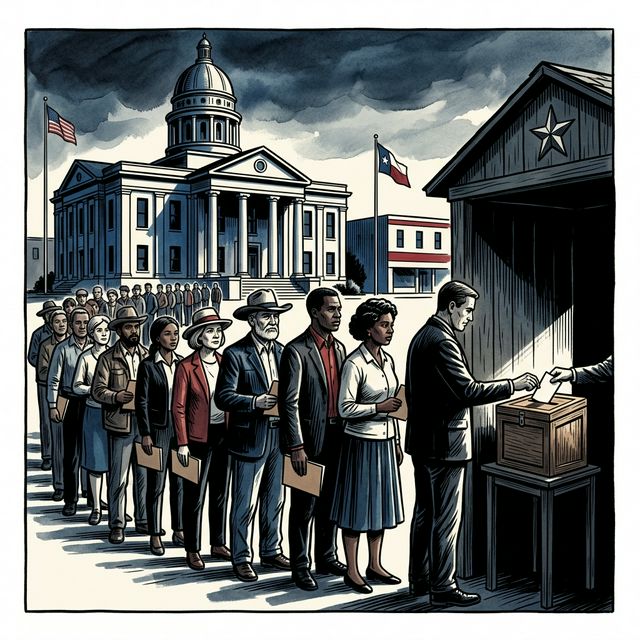
On March 3, Bastrop County held its 2026 primary election. Out of 62,294 registered voters, only 18,606 showed up. That is a 29.9% turnout rate.
Let that sink in. Seventy percent of registered voters in Bastrop County sat this one out.
This was not a sleepy local race with nothing on the ballot. Texas voters chose candidates for U.S. Senate, Governor, Attorney General, state House, and county-level offices. The Republican Senate primary between John Cornyn, Ken Paxton, and Wesley Hunt drew national media attention and tens of millions of dollars in advertising. And still, seven out of ten Bastrop County voters stayed home.
If you are a conservative in Bastrop County, this number should keep you up at night. Here is why.
The Turnout Picture Is Getting Worse, Not Better
Bastrop County’s voter rolls have grown 38% since 2016, from about 45,000 registered voters to more than 62,000 today. That growth reflects a county that has added nearly 50,000 new residents in the past decade and a half. More people, more voters, more registrations.
But registration does not equal participation. Look at the trend:
- 2016 Presidential: 63.0% turnout (28,424 voted of 45,137 registered)
- 2018 Midterm: 60.0% turnout (27,662 voted of 46,416 registered)
- 2020 Presidential: 70.3% turnout (36,612 voted of 52,096 registered)
- 2022 Midterm: 52.4% turnout (29,232 voted of 55,779 registered)
- 2024 Presidential: 65.0% turnout (39,956 voted of 61,423 registered)
- 2026 Primary: 29.9% turnout (18,606 voted of 62,294 registered)
Presidential years bring people out. Midterms drop off. Primaries collapse. This pattern is not unique to Bastrop County, but the gap between our registration growth and our primary engagement is alarming.
Statewide, overall turnout was 22.1%, so Bastrop County at 29.9% actually outperformed the Texas average. But that is a low bar. And it should not give anyone comfort.
Why Primaries Matter More Than You Think
In Bastrop County, Republicans dominate general elections. Donald Trump carried the county 58.6% to 40.1% in 2024. For most local and county races, the Republican primary IS the election. Whoever wins the GOP primary is almost certainly going to win in November.
That means the 29.9% of voters who showed up on March 3 effectively chose the candidates who will govern Bastrop County for the next two to four years. The other 70% handed that decision to someone else.
When primary turnout is this low, a small number of highly motivated voters can determine outcomes. That can work in favor of incumbents, well-funded candidates, or organized factions, regardless of whether they represent the broader values of the community.
For conservatives, there is no bigger missed opportunity than a low-turnout primary. This is where your vote carries the most weight per capita of any election on the calendar.
The May 26 Runoff Is the Next Test
The March 3 primary is over. But the consequences are still playing out. John Cornyn and Ken Paxton are headed to a May 26 runoff for the Republican U.S. Senate nomination after neither cleared 50% in the first round. Cornyn finished at 42%, Paxton at 41%, with Wesley Hunt taking most of the remainder.
This is one of the most consequential Republican primaries in Texas in a generation. The winner faces Democrat James Talarico in November in what both parties acknowledge will be a competitive general election. Democrats have not won a statewide race in Texas since 1994, but party operatives on both sides say this cycle presents a real opening.
The dynamics of a runoff favor the candidate with the more engaged base. Pro-Paxton groups have already pointed out that the activist-driven, MAGA-aligned voters who form his coalition are the most likely to return for a second round of voting. Meanwhile, the more moderate and casual Republican voters who tend to favor an incumbent like Cornyn are the least likely to vote a second time.
As of this writing, Trump has not endorsed either candidate, though the deadline to withdraw from the runoff ballot has passed. Both Cornyn and Paxton will appear on the May 26 ballot. Wherever you stand on that race, one thing is certain: the voters who show up will decide it. And if Bastrop County’s primary turnout is any guide, the vast majority of registered Republicans will not be among them.
The Growth Factor Makes This Urgent
Bastrop County is not the same place it was ten years ago. The population has surged past 122,000, up from 74,000 in 2010. More than 3,100 new domestic migrants arrive every year, and 38% of them come from Travis County. Another 22% come from out of state, with California, Washington, and New York leading the list.
These new residents are registering to vote. The voter rolls reflect it. But we have no guarantee that they share the same conservative values that have defined Bastrop County for decades. Every election cycle that passes with low conservative engagement is an election cycle where the political character of this county drifts further from the people who built it.
Consider: if the roughly 43,000 registered voters who sat out the March primary had participated, the results could have looked dramatically different. In a county growing this fast, with this many new voters, low turnout is not just apathy. It is a structural risk to the conservative majority.
What You Can Do Right Now
The Cornyn/Paxton runoff on May 26 is the immediate next opportunity. Here is what matters:
1. Mark Your Calendar. The May 26 runoff is not a suggestion. It is a date. Early voting runs from May 9 through May 22. If you cannot make it on election day, vote early. There is no excuse.
2. Confirm Your Registration. If you have moved within or into Bastrop County recently, your registration may need updating. Visit bastropvotes.org or stop by the Bastrop County Elections office at 804 Pecan Street. The last day to register for the runoff is April 27.
3. Bring Someone With You. The single most effective thing any voter can do is bring one additional person to the polls who would not have gone otherwise. If every conservative who voted in March brings one friend or neighbor to the May runoff, we double our impact.
4. Pay Attention to Local Elections. The May 2 uniform election includes school board races, city council seats, and bond measures. These races are decided by tiny margins because almost nobody votes in them. That is where your vote has the most outsized influence.
5. Stay Engaged Beyond Election Day. Attend a county commissioners court meeting. Go to a school board meeting. Show up at a candidate forum. The people making decisions about your tax dollars, your kids’ education, and your property rights are counting on you not paying attention.
The Bottom Line
A 29.9% primary turnout rate in a county with a 58.6% conservative advantage is not just disappointing. It is dangerous. Bastrop County is growing fast, the voter rolls are swelling with new registrations, and the political makeup of the newcomers is an open question.
The conservative majority here was not given to us. It was built by people who showed up, cycle after cycle, for decades. Keeping it requires the same commitment.
The May 26 runoff is in 68 days. Early voting starts in 51 days. Registration deadline is April 27.
The only question is whether you will be part of the 30% who decide, or the 70% who let someone else decide for you.
Voter data sourced from the Bastrop County Elections Office, Texas Secretary of State, and the RedStateTexas.com/BastropCounty election intelligence dashboard. For the full interactive dashboard with voter turnout, migration patterns, and partisan analysis, visit RedStateTexas.com.
Bastrop County Conservatives is a community organization dedicated to promoting conservative values and civic engagement in Bastrop County, Texas. Visit BastropCC.com to get involved.