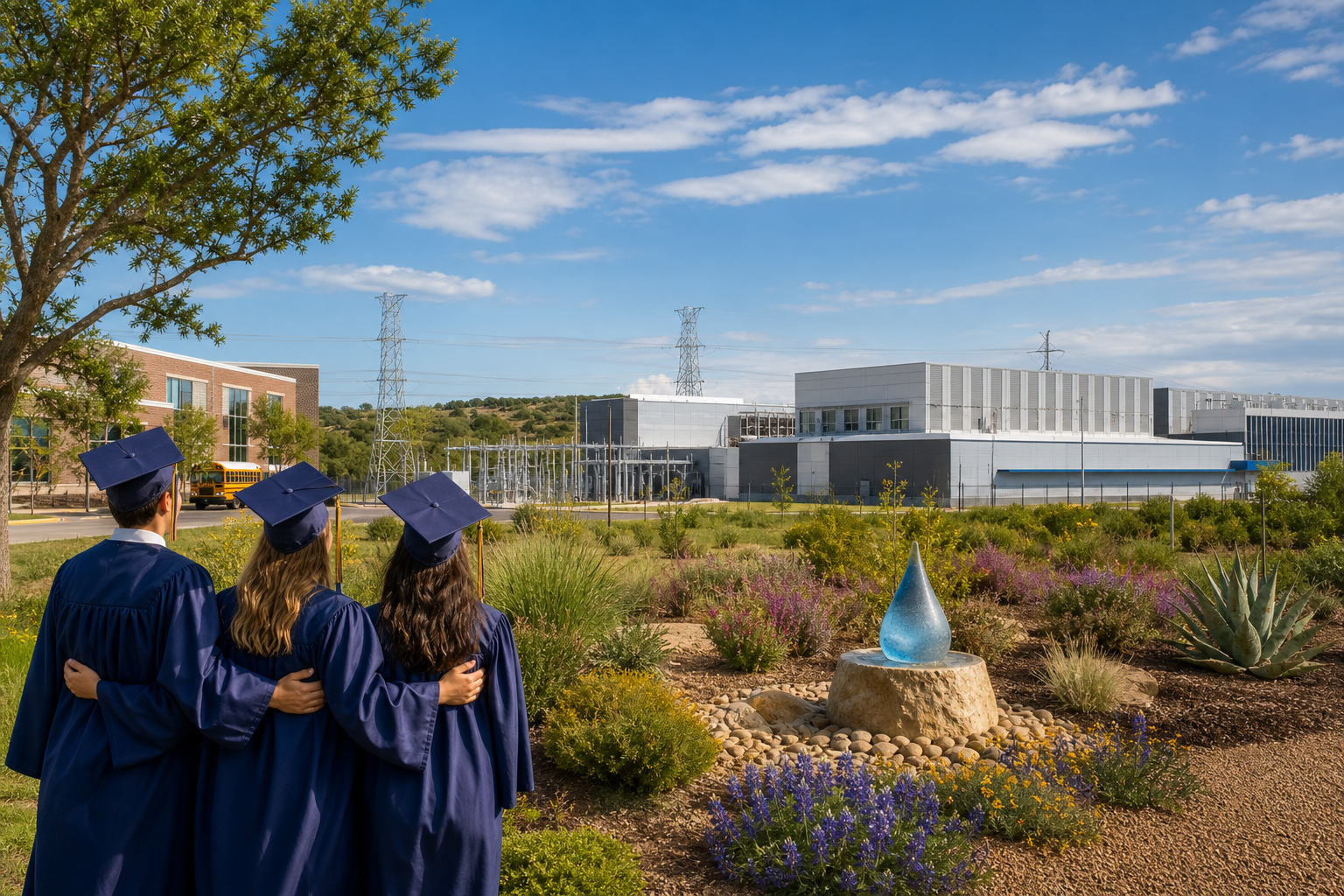
There’s a lot of noise out there about the data center coming to Bastrop County, so let’s cut through it with the actual numbers.
EdgeConneX is building a data center campus in Bastrop County, and the facts behind the project tell a story that’s easy to miss when the conversation gets loud: hundreds of skilled jobs, more than a billion dollars in new tax revenue for our schools and county services, a multi-year investment in our kids’ education, and a design built specifically to protect the one thing everyone is rightly worried about, our water.
Here’s what the project actually means for the people who live here.
The Economic Case Is Hard to Argue With
Bastrop County doesn’t get many chances at an investment of this size. This one is generational.
Over its first 20 years, the campus is projected to generate $1.6 billion in total tax revenue for local taxing entities. That’s not a vague promise. Here’s where it lands:
- Bastrop ISD: $1.168 billion
- Bastrop County: $287 million
- Emergency Services District 3: $109 million
- Emergency Services District 1: $87 million
That tax revenue starts flowing when construction begins, not years later when the buildings open, so the community sees the benefit early.
On an annual, stabilized basis, the net fiscal benefit comes out to roughly $51 million a year for Bastrop ISD and $22 million a year for the county, even after accounting for added service costs. For perspective, the data center campus generates tax revenue equivalent to more than 5,000 homes, but with only a fraction of the strain on roads, schools, water, and public services that 5,000 new houses would bring. Compared to a warehouse or logistics park on the same land, it produces 8 times or more the property tax with about a tenth of the public-services burden.
That’s the quiet truth about data centers: they pay a lot and ask for very little in return.
Real Jobs, Real Careers, Not Just Construction
The campus is expected to create 200+ direct permanent jobs with a combined $16 million annual payroll, plus hundreds of daily on-site construction jobs during the build.
These aren’t dead-end positions. Entry-level data center roles in this field typically pay $55,000 to $65,000, and the career ladders are real: chief engineers, electricians, HVAC technicians, mechanical and plumbing techs, NOC/operations technicians, facilities engineers, and security personnel. U.S. data center employment grew about 60% between 2017 and 2023, and demand is accelerating, which is exactly why building the local talent pipeline matters.
EdgeConneX is investing in that pipeline directly. The company is helping stand up the Bastrop County Technical (BCT) education center, a shared community resource offering hands-on training in data center operations and skilled trades, and it’s funding an AI & STEM program across all four county school districts: Bastrop ISD, Elgin ISD, McDade ISD, and Smithville ISD, with commitments running through the 2029 to 2030 school year. Partnerships with Austin Community College, Texas A&M, Texas State Technical College, and UT round it out. The goal is straightforward: when these jobs open up, Bastrop County kids and workers are first in line for them.
Now, About the Water
This is the concern that matters most to people here, and it deserves a straight answer.
The Bastrop campus is designed around a closed-loop cooling system. That means the cooling water is recycled continuously inside the facility rather than constantly pulled from local sources. Landscaping is fully xeriscaped, so irrigation water use is zero.
The headline number: total peak daily water demand for the data center is about 2,640 gallons per day, roughly the same as five average Texas homes, or a small cul-de-sac. Put that next to other buildings that could go on commercial land:
- A mid-rise office building uses about 30,000 gallons a day, roughly 12 times more water than this data center.
- A logistics and distribution center uses around 5,600 gallons a day, more than double.
On top of designing for low demand, EdgeConneX is actively pursuing non-potable, brackish (naturally salty) groundwater that doesn’t compete with residents’ drinking water, and is working with Aqua Water Supply and the Lost Pines Groundwater Conservation District to protect the freshwater aquifer.
It’s also worth zooming out, because the national fear doesn’t match the national data. As TomorrowBeginsHere.com lays out, all U.S. data centers combined used less than 0.5% of America’s total freshwater in 2023. For comparison, agricultural irrigation accounts for roughly half of all U.S. freshwater use, and leaky municipal pipes lose about 3 trillion gallons a year, around 15 times more water than data centers consume. The idea that a closed-loop facility using the equivalent of five homes will “drain the county” simply isn’t supported by the math.
The Governor Just Drew the Same Line in the Sand
If you want a sense of where the guardrails are headed, look at what Texas Governor Greg Abbott said this month. His office laid out three bottom-line expectations for data centers coming to Texas: they must bring their own power, they must reuse their own water, and they must reduce electricity costs for residential and small business customers. In his words, “Those are bottom-line expectations.”
Here’s why that’s reassuring for Bastrop: the EdgeConneX project is already built around exactly those principles. Closed-loop cooling is water reuse. The state is now moving to require the water-efficient, closed-loop technology this campus already uses, to mandate annual water and electricity reporting, and to ensure data centers pay for their own power infrastructure so residential ratepayers aren’t stuck with the bill. The project isn’t running ahead of regulation. It’s running in the same direction.
Built to Be a Good Neighbor
Responsible design goes beyond water. The campus plans include rooftop sound barriers, attenuators on chillers, and acoustic enclosures for generators, with full acoustical modeling of the site and surrounding area to keep noise down for nearby residents. Before it can operate, the facility must obtain an air permit from the Texas Commission on Environmental Quality (TCEQ), consistent with state and federal regulations. EdgeConneX is also contributing to TxDOT road improvements that benefit the whole community and has committed to dedicating 25 acres for a community park.
The Bottom Line
Bastrop County is being asked to weigh a real opportunity against a set of fears, and when you put the fears next to the facts, the facts win:
- $1.6 billion in tax revenue over 20 years, with the lion’s share going to our schools.
- 200+ permanent jobs and a homegrown training pipeline for local students.
- Water use equal to about five homes, with zero irrigation, closed-loop reuse, and a plan to use non-potable water.
- A design that already meets the standards the Governor of Texas is now requiring statewide.
Growth done right doesn’t mean choosing between prosperity and protecting what makes Bastrop County home. This project is a chance to have both.
Have questions about the project? EdgeConneX has invited residents to reach out directly at BastropInfo@edgeconnex.com.